A great procurement process flow can help your business maximise productivity and profitability. Among others, it leads to significant time and cost savings, better efficiency, and increased compliance.
Therefore, businesses are constantly on the search for how to make their process flow better.
In this article, we will explore the ins-and-outs of procurement process flow. From procurement basics to the challenges (and solutions!) of procurement, get the know-how of improving your process flow today.
What is the Procurement Process Flow?
The procurement process flow is a systematic framework that outlines the sequence of activities involved in acquiring goods, services, or works within an organisation. It encompasses all steps from identifying needs to the final payment and contract closure.
While various models exist to describe the procurement process, one useful framework is the 3Ps model, which highlights three critical aspects:
- People: This refers to the group of people involved at each stage of the procurement process. For example, managers of various departments in the organisation and certain committees (e.g., purchasing committees). The higher the value or risk, the more stakeholders are involved.
- Process: This refers to the sequence of steps followed to identify needs, select suppliers, place orders, receive goods or services, and make payments. This process can vary between organisations, where higher value materials may require more complex processes and vice versa.
- Paperwork: This refers to the documentation or paperwork required at every stage of the procurement process, such as requisition forms, purchase orders, and invoices. These documents, which are proof of transactions, must be maintained for accounting and auditing purposes.
What are the Types of Procurement Process Flow?
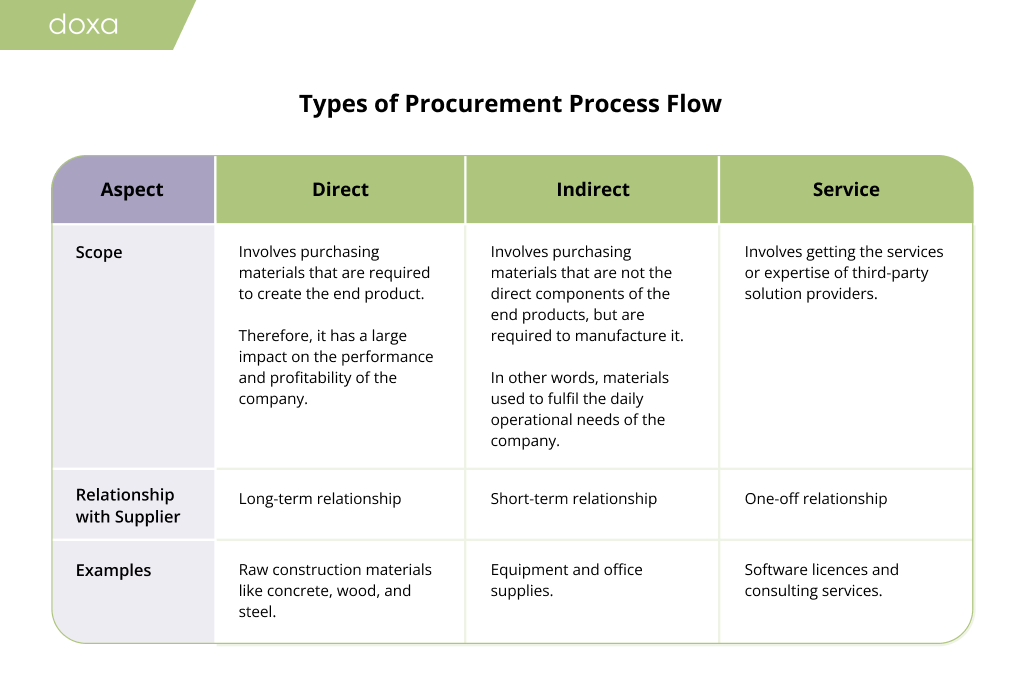
Here are the three primary types of procurement process flow:
Stages in a Procurement Process Flow
The procurement process flow consists of eight key stages. However, it’s important to note that this process is not one-size-fits-all.
Organisations often customise the procurement flow to suit their specific needs, industry requirements, and operational structure. This customisation may involve adding, removing, or modifying certain stages.
Now let’s dive deeper into each stage:
Step 1: Identify the Need
The procurement department receives requests from various branches of the company or proactively inquires about their needs.They analyse these needs and begin planning the procurement process.
Step 2: Select the Vendor
The procurement team researches and requests quotes from potential vendors. Vendors are evaluated based on criteria such as cost, reliability, quality, and delivery speed. The most suitable vendor is selected.
Step 3: Submit Purchase Request
An employee prepares a purchase requisition (PR) detailing the required materials, quantities, and specifications. This request is submitted for approval to the authority in charge of purchases within the company.
Step 4: Prepare and Send Purchase Order
Once the purchase request is approved, the procurement or finance department issues a purchase order (PO) to the chosen vendor. The PO includes details such as item descriptions, quantities, agreed prices, delivery dates, and terms and conditions.
Step 5: Receive Order Confirmation and Invoice
The vendor sends an order confirmation to acknowledge receipt of the PO. The vendor also issues an invoice detailing payment terms, unit costs, total amount due, and any shipping and handling charges.
Step 6: Oversee Delivery
The buyer monitors the order status and communicates with the vendor to ensure timely delivery. Upon receipt, the materials are inspected to verify quality and quantity against the PO.
Step 7: Process Payment
After confirming the received goods match the order, the finance department processes the payment according to the agreed terms. This may involve three-way matching of the PO, receiving report, and invoice.
Step 8: Record Transactions
All procurement-related documents and transactions are recorded in the company’s financial system. This documentation is maintained for accounting, auditing, and compliance purposes.
Challenges in the Procurement Process Flow
Here are a few challenges your company is bound to face in procurement:
Fragmented Supplier Base
Globalisation has led to the age of fragmented supplier bases, where an organisation purchases similar goods or services from numerous, similar suppliers. This stretches your spend over a large number of suppliers and reduces your control over the pricing.
This can lead to inconsistent pricing, quality variations, and increased complexity in supplier management. It may also result in missed opportunities for bulk discounts and strategic partnerships.
Moreover, the COVID-19 pandemic is a cautionary tale for all organisations, showing just how disruptive and damaging a global breakdown of supply chain is to the procurement process.
Efficiency Trap
The efficiency trap refers to a situation where organisations focus too heavily on cost-cutting and efficiency measures at the expense of innovation and long-term value creation.
Research on the Department of Correctional Facilities reveals that the procurement managers of this department chose to focus on objectives that were unbeneficial, rather than improve service delivery and long-term profits.
Additionally, the managers preferred familiar strategies over aligning with the organisation’s broader goals. Ultimately, efficiency traps lead to missed opportunities for strategic sourcing and supplier-driven innovation.
Maverick Spending
Maverick Spending, also known as rouge spend, occurs when employees make purchases outside of established procurement channels, supplier, and price. According to the Hackett Group, the top reported causes of Maverick Spending are technological and cultural factors:
- lack of self-service or guided buying tools
- non-compliant mentality
- resistance to behavioural changes
- procurement processes that are complex or require staff training.
This can lead to higher costs, non-compliance with organisational policies, and reduced visibility into overall spending patterns. More specifically, this spending can lead to consequences such as lower sourcing leverage from fragmented spend, higher purchasing process costs, and higher supply-base risk.
Manual and Traditional Processes
Reliance on manual, paper-based processes slows down procurement activities, increases the risk of errors, and limits visibility into the procurement pipeline.
You may face frustrating issues like missing documentation and patchy administration, as physical documents need to be sent back-and-forth and to multiple stakeholders.
This reliance may be due to the employee’s resistance to change. Many organisations face internal resistance when implementing new procurement processes or technologies.
Employees may be comfortable with existing methods and reluctant to learn new systems.
Revolutionize Your Construction Workflow
Transform Operations with Seamless Integration and Real-Time Tracking
How Do I Ensure the Efficiency of the Procurement Process Flow?
Now that we’ve gone over the challenges, let’s take a look at how we can overcome them:
Narrow Down and Consolidate Suppliers
Experts recommend consolidating multiple services from single suppliers. This will help organisations to increase their purchasing power, and cut down on spending and landing costs. Moreover, they can eliminate inefficiencies and reduce the extra resources required to manage multiple suppliers.
By narrowing down the number of suppliers, this solution also enhances the organisation’s ability to verify supplier compliance and foster stronger relationships with them. Plus, you have more power to negotiate better prices, because selected suppliers can expect a larger spend from you.
Invest in Training Your Workforce
Regular training keeps procurement staff up-to-date with best practices, new technologies, and relevant regulations. This investment can help the procurement team improve their skills, leading to better decision-making and more efficient processes.
By fostering a continuous learning culture through mentorship programs, industry conferences, bursaries, learning courses, and knowledge-sharing platforms, organisations can ensure their procurement teams stay at the forefront of industry trends.
Standardise Your Processes
Standardising processes across the organisation is essential for consistency, compliance, and continuous improvement in procurement.
This starts with documenting procedures in detailed, easily accessible guides and implementing workflow automation to enforce standardised approval processes. Developing templates for common documents and clearly defining roles and responsibilities helps streamline operations.
Regular process reviews, involving team members at all levels, allow for the identification of bottlenecks and areas for improvement. A robust change management strategy, which includes providing support to employees, is also crucial when implementing new standardised processes.
Choose a Suitable Procurement Software
Did you know the global procurement software market is projected to be worth $9.5 billion by 2028? This shows the increasing need for tools to enhance the procurement process flow.
Selecting the right procurement software can streamline processes, improve visibility, and provide valuable data for decision-making. One of the major features of this software is the automation of time-consuming tasks, which reduces the need for manual work.
Implementing automation for routine processes such as purchase order creation, invoice processing, and approval workflows can significantly shorten processing times and minimise errors.
The software should be chosen based on the organisation’s specific needs, and should be able to integrate with other relevant systems (e.g., existing ERP and accounting systems).
Related Articles: Why ERP isn’t Enough for Construction Payment Management
Bonus: How to Tackle Resistance to Change
When organisations implement changes to their procurement process, they often face resistance from employees. Research reveals that the social aspects of change have a larger impact than the technical aspect.
Experts advise those proposing change to prioritise understanding and respecting the existing working relationships among the staff affected, rather than solely focusing on the efficiency of the new system. This approach fosters better collaboration between parties and ensures a smoother transition.
In terms of procurement software, partner with providers that offer robust support to ease the implementation and transition process. This minimises downtime and allows your business to run as usual.
How Doxa Connex Helps You Enhance Your Procurement Process
Not sure where and how to start? Doxa has the answer!
Doxa Connex is a collaborative trade platform that provides an end-to-end solution for procurement, payment, and financing. This platform automates and digitalises your processes – helping you save costs, increase efficiency, and free up time for higher value work such as innovation and expansion.
Doxa Connex can smoothly integrate with most ERP and accounting systems, like SAP, Oracle, SAGE, Autocount and more via API, SFTP, or other methods. Doxa’s experienced team also handles the supplier onboarding, providing training and support to bring suppliers to the platform for collaboration.
Here are the primary solutions Doxa Connex offers:
- Cost Reduction: Our clients have experienced an up to 49.2% reduction in manual hours spent on workflow. Doxa Connex helps you automate processes (e.g., payments from main contractors to suppliers), reducing manual work, increasing accuracy, and letting you focus on what matters.
- One System For All Your Process: Doxa Connex is an end-to-end system that manages documentation such as Request for Quotes, Purchase Requests, Purchase Orders, Invoices, and Payment Tracking. We remove the need for paper-based documents and endless back-and-forths.
- A Single Source of Information With a Cloud Platform: Doxa Connex acts as a single source of truth for all your projects, providing easy access to all your data and simplifying collaboration between stakeholders. Our dedicated mobile app further enhances on-site productivity.
- Specially for the Built Environment: Doxa Connex is designed for contractors, sub-contractors, and suppliers in the Singapore built environment. We are modelled towards the Building and Construction Authority’s (BCA) recommendations.
Visualise how Doxa transforms your workflow with our comparison of Traditional Procurement Process Vs. Procurement Process With Doxa Connex:
 Traditional Procurement Process
 Procurement Process With Doxa Connex
“With Doxa Connex, Kimly was able to save about 30 percent of man hours in payment processing for its suppliers and contractors.”
– Mr Louis Khoo, director of Kimly Construction
Source: Green Trade Finance Goes Digital to Help SMEs Run Efficiently and Sustainably
Transform Your Procurement Process Flow With Doxa Connex
From this overview, we can see that organisations face many challenges in improving their procurement process. With the ever-evolving procurement environment, they need to constantly innovate and upgrade their processes to stay competitive, maximise value, and mitigate risks.
At the forefront of this ongoing evolution is: embracing new technologies.
Enter Doxa Connex – a premier platform connecting buyers, suppliers, and financiers effortlessly. Built on a strong enterprise-grade foundation, our highly flexible platform allows us to constantly add, improve and enhance features and workflows, especially for the construction industry.
To provide the best value for buyers, we’ve partnered with leading financial institutions including Maybank, UOB, OCBC, and more. Our platform is trusted by prominent players in the construction industry such as Tiong Seng Group, Kimly Construction, and Sim Lian, creating a thriving ecosystem for growth.
Curious how Doxa Connex unleashes the full potential of your procurement process flow?
Streamline Your Procurement Process
Enhance Efficiency and Cut Costs with Our All-in-One Platform